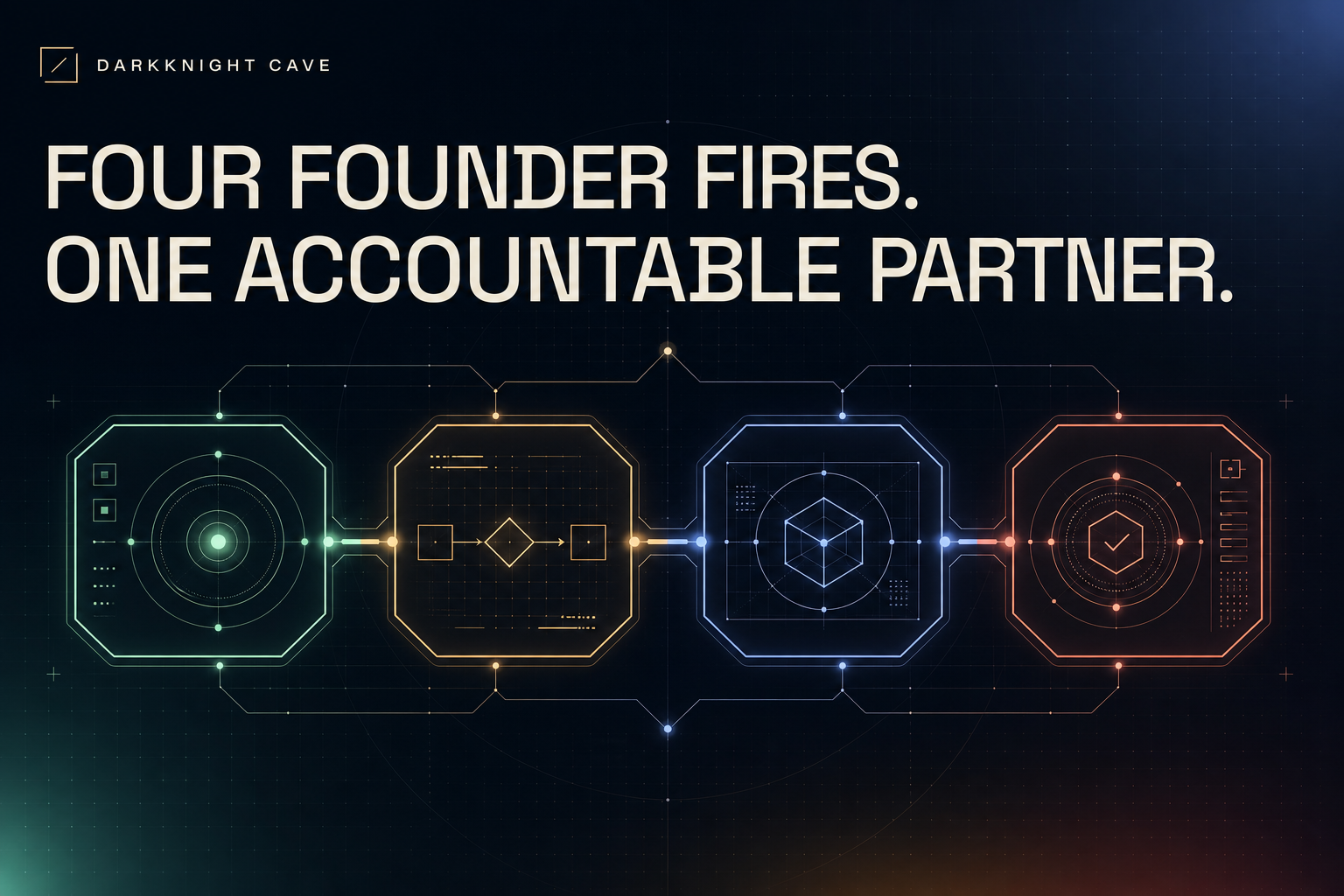
DarkKnight Cave had 4 connected service lines, but its capability list did not explain why a growing business should care. The site needed to begin with the problems clients recognize, show how the work connects, and make post-launch ownership visible.
The brief
The offer covered AI agents, custom software, SEO and GEO, automation, QA, and maintenance. Presenting those as separate service cards made the company look like another generalist shop.
We rebuilt the story around five fires that show up inside growing businesses: poor visibility, abandoned carts, repetitive support, a stalled product, and operations held together by manual work. Each problem leads into a practical fix and an owned system.
- Audience
- E-commerce, startups, and scaleups
- Delivery
- Static Next.js site
- Content model
- Problem to system ownership
Turning the position into a page
The homepage opens with the promise. From there, visitors move through the five fires, the work behind them, the connected services, and a 3-question project intake.
We use each core color for a specific job: red flags the problem, the work moves through blue, and outcomes land in green. This gives long pages a readable rhythm without adding decorative labels to every section.
The build
We used Next.js and React for the site, with GSAP and Three.js handling the visual systems and scroll-driven transitions. The production build exports static files, which keeps the public site independent of a runtime server.
The service content lives in structured data instead of being copied into each page. One record supplies the page promise, problems, offer, deliverables, process, audience, and FAQs. That keeps navigation cards, service pages, and metadata aligned as the offer changes.
Decisions that mattered
Put the problem before the service
A founder may not know whether a broken handoff needs an integration, an internal tool, or a change in process. The site lets them begin with the thing that is stuck.
Keep senior ownership visible
The copy explains who scopes, builds, reviews, and stays after launch. We repeat that point throughout the site instead of adding a longer technology list.
Give experiments their own room
Labs holds useful early tools and visual experiments without making the main offer harder to understand. Finished tools can move into the tools section when their job is clear.
Build publishing into the same system
The blog and case-study sections use MDX, so written stories can include React components, images, galleries, and video while still shipping as static pages. The content stays in the repository with the code that presents it.
What the site now makes clear
Visitors can enter through a business problem, a service, a case study, or a field note. Every path leads back to the same promise: DarkKnight Cave scopes the work, helps build it, and stays accountable after launch.
The Rivergate Supply and GoCodeMinder case studies that followed replaced that broad description with the specific constraints, decisions, media, and outcomes from real client work.